Monday, March 17, 2014

Moontalkers

This week I'm attending the 45th Lunar and Planetary Science Conference in Houston, which is basically an annual gathering of the world's biggest space geeks. And today we were treated to some space geek royalty. Not one, but two, of the 12 Apollo 'moonwalkers' spoke to captivated audiences over the lunchtime period.

First, Harrison 'Jack' Schmitt (the only geologist to have walked on another planet) talked about the scientific discoveries that his mission, Apollo 17, has yielded in the subsequent 30+ years. 

Jack Schmitt sampling conducting fieldwork on the Moon during Apollo 17. Credit: NASA/Eugene Cernan
And then we were treated to a fascinating planetary travelogue as Dave Scott, the commander of Apollo 15, challenged the scientists in the room to go forth and work with the engineering community in a synergistic way to design more capable, exciting, and scientifically meaningful lunar (and martian) missions for a new century.

Commander of Apollo 15, Dave Scott, saluting the American flag in 1971. Credit: NASA
So today, instead of choosing a rock from Earth to send forth into the cosmos, I'm including two quotes with which Dave Scott ended his presentation: 

"Man must rise above the Earth—to the top of the atmosphere and beyond—for only then will he fully understand the world in which he lives."
Socrates 469–399 BC

"What was most significant about the lunar voyage was not that man set foot on the moon but that they set eye on the earth." 
Norman Cousins, Cosmic Search magazine, volume 1, number 1, January 1979

These beautifully encapsulate the reason why the hundreds of scientists in the audiences today (including myself) do what we do. For a few years back in the 1960s and 1970s Dave Scott, Jack Schmitt, and all the other Apollo astronauts were our very own human interplanetary messengers. They were sent forth to explore another world, and to bring back pieces of it so that we can learn about our home and its place in the universe. Their mission was not chosen for its ease, but because it was hard. Because that goal served to organize and measure the best of humankind's energies and skills. I think we are more than overdue a renewal of quests such as these. It's time to inspire a whole new generation of scientists and engineers.

A slightly blurry Dave Scott and me in Houston, 17 March 2014.
Today I got to meet one of my heroes. And he reminded us all that our Earth is a beautiful and special place. More wonderful, dare I say, than can ever be represented by one rock.

"The blue marble", taken from Apollo 17. Credit: NASA

Thursday, February 27, 2014

Zirvivors

As a planetary geologist studying the surface of the Moon and Mercury, I think daily about old rocks—up to about 4.5 billion years old. These planetary bodies—smaller than our Earth—have ancient crusts, which have not been greatly disturbed or overhauled through their history. They do not have operating plate tectonic systems to create and destroy crust in long and regular cycles. Nor do they (currently, at least) have surrounding atmospheres with active climates to weather and erode surface materials. This means that the rocks on the Moon and Mercury are witnesses to the earliest part of the inner solar system's history—a record that has been almost completely erased from the surface of Earth.

The heavily cratered surfaces of the Moon (left) and Mercury (right) bear the scars of many meteoroid impacts that have occurred during their 4.5-billion-year lifetimes. Credit: NASA
When I first started thinking about this blog and its central theme, it seemed to me that one of the most obvious rocks to best represent the Earth would be the oldest. But deciding on what is truly the oldest terrestrial rock is not as easy as it sounds. Rocks are made up of minerals, and over time, the rocks may be changed through the actions of heat, pressure, and/or chemistry so that the original rock gets broken down. At least some of the constituent minerals, however, can survive and become incorporated into new rocks.

Some of my colleagues at the Department of Terrestrial Magnetism work on the analyses of rocks that are amongst the most ancient found on Earth, but I want to leave those as a subject for another postcard and another day. Instead, I want to focus here on the oldest minerals that have yet been discovered.

New work published this week in Nature Geoscience provides an age for what is thought to be the oldest fragment of material from Earth's crust. This grain is a fragment of the mineral zircon. Zircons are found ubiquitously in all kinds of rocks—igneous, metamorphic, and sedimentary. They are hard (with a value of 7.5 on the Mohs hardness scale), which together with their chemical inertness, means they are difficult to destroy. A very ancient zircon grain can therefore have inhabited a number of different rocks during its lifetime. In the new work conducted by John Valley, from the University of Wisconsin, and coauthors, a zircon grain from a sandstone outcrop in the Jack Hills of Western Australia is shown to be 4.4 billion years old.

Fragment of a 4.4 billion year-old zircon grain (about 0.5 mm in length). Credit: John Valley
Valley and his team used a radiometric dating technique to find the age of this rare mineral fragment. Although zircon is composed almost entirely of the three elements zirconium, silicon, and oxygen, other elements can be incorporated into its mineral structure in very small (trace) amounts as it grows. In particular, they measured the numbers of uranium and lead atoms in the sample. Certain isotopes of uranium decay at fixed rates to form isotopes of lead. If a specific sample has remained a 'closed system', the number of these measured uranium and lead isotopes can be used as a chronometer to tell us the age of the sample.

This zircon fragment dates to the Hadean eon—Earth's earliest geologic period—that was characterized by hot and violent conditions. The grain, along with other slightly younger zircons, is evidence that a solid crust formed soon (geologically speaking) after Earth's formation (about 4.6 billion years ago) and the giant impact event that likely formed the Moon and created an Earth-wide expanse of molten material, known popularly as a 'magma ocean'.

View on Earth during the Hadean eon? Credit: Mark Garlick - Space Art

The majority of Earth's surface may not be as old as what we see on some of our solar system neighbors, but these little zircon pieces from Australia are about as old as we are going to find. If they have survived this long, I think that they should definitely make the celestial trip to meet our alien planetary geologists. Perhaps our hypothetical friends are somewhere 4.4 billion light-years away and can even observe the Hadean Earth firsthand.

Wednesday, February 19, 2014

Please, sno' more

I'm sure I'm not alone as I happily anticipate the first stirrings of spring here on the US east coast. I'm not a fan of winter. Or snow. Sure, it looks pretty for a while, but then it just gets in the way of every day life. I'm more than ready for this week's thaw.

I was contemplating all this as I sat on the bus yesterday morning, watching the piles of dirty DC snow on the sidewalks rush past me. I realised how thankful I am that we live on an Earth that is not covered with snow ALL the time. But then I remembered, our world hasn't always necessarily been like this.

The grey, gloomy, and snow-covered National Mall; slippery conditions prevail.
If we were to go back 650 million years, and then some, we would probably find an Earth with a very different climate. Geologists have long thought that this ancient period was one of a 'snowball Earth', when the surface was entirely (or almost) frozen.

The term for this hypothesis was first coined by Caltech scientist Joseph Kirschvink in 1992, but the idea of a global glaciation had previously been proposed to explain, for instance, glacial rock deposits in places such as Greenland. These rocks, known as tillite, are formed when glacial till—basically the unsorted crud that glaciers pick up, drag along, and then deposit as they melt—becomes lithified. Finding this kind of material in chilly places like Greenland shouldn't really be much of a surprise. But the rocks in question are old. Very old. And the process of continental drift means that Greenland's current position in Earth's northern latitudes was not its location when these rocks formed.

By studying the magnetism of certain minerals, which capture the direction of the surrounding magnetic field as they form, 'paleomagicians' are able to reconstruct the position of ancient continents around the globe. Such paleomagnetic studies on the tillites from Greenland show that they formed at tropical latitudes, where the Earth receives more (because of Earth's tilt on its axis) of the Sun's warming radiation—hardly where you might expect glaciers to exist.

Tillite deposit in East Greenland. Credit: M. Hambrey
And there are plenty of other distinctive rock types (e.g., banded iron formations and cap carbonate rocks) that date from this same era, which appear to be evidence of a global glaciation. But how could this state of Earth-wide freezing have occurred?

Climate models show that if sea ice advanced far enough towards the equator then a positive feedback system would have been established. The bright albedo (reflectance) of sea ice versus seawater means that more radiation is reflected away from the water in its solid form. So if the area of Earth's surface that was covered by ice increased, more light would have been reflected away and the Earth would have cooled. This would have led to more ice formation and more reflection and more cooling... You get the idea.

How Earth may have looked during a 'snowball Earth' episode.
Credit: geology.fullerton.edu
So if the snowball Earth really did exist, how did the planet get itself into such a state in the first place and how did it manage to escape?

To start the ice formation, obviously there had to have been some kind of large-scale initial cooling event. Options include: a supervolcano eruption that may have thickened the atmosphere and reduced the amount of radiation received from the Sun, or perturbations in the Earth's orbital dynamics (which follow the Milankovitch cycles) that brought the planet into a particularly cold configuration.

And greenhouse gases—namely carbon dioxide and methane—were probably the route for escape from Earth's frozen hell. In much the same way that the build-up of these molecules in today's atmosphere is to blame for global warming, the steady increase of their concentration in our ancient atmosphere could have allowed the huge accumulations of ice to thaw and melt. It has been estimated that about 350 times the concentration of carbon dioxide in today's atmosphere were needed to achieve such a feat. And it seems that volcanic eruptions, occurring over tens of millions of years, could have emitted these gases in the required quantities to melt ice in the tropics. This would have initiated an opposite feedback loop and would bring sea ice levels down to the more modest quantities of more modern times.

Although the snowball Earth hypothesis is still disputed, the fact that it immediately precedes the large-scale development of multi-cellular life—popularly known as the Cambrian explosion—is an intriguing fact. I think, therefore, at least one of the rock samples that serve as evidence for this hypothesis warrants being sent into space for another planetary geologist to recover. They are testament to the winter of our Earth's discontent and the conditions that had likely stifled the blossoming of life.

Bring on the spring. I eagerly await the sight of Washington DC in full blossom again.

Friday, February 07, 2014

What's up Sun?

For this postcard from planet Earth I've decided to cheat a bit on my own rules and pick a rock that isn't necessarily of the Earth, even if it is on the Earth. Mainly because I wanted to write about something close to my heart.

Let me explain.

I recently read this article in Scientific American. The research it highlights describes how interactions between solar wind and interplanetary dust particles can produce water. This got me thinking about how the Sun is a vital piece in creating our habitable little part of the solar system / galaxy / universe. (It also links nicely to my previous postcard, where I discuss how water might originally have been brought to Earth.)

The solar wind is a stream of charged particles (mostly electrons and protons) released from the Sun's upper atmosphere. This stream can vary, over time and from location to location around the Sun, in its density, temperature, and speed.

During solar flares, strong blasts of solar wind are fired through the solar system.
Credit: NASA
Now, even though I am a geologist and I spend most of my working hours thinking about rocks on planets other than our own, I also spend a fair bit of time thinking about the Sun. And worrying about the Sun.

You see, as a PhD student I waited (not necessarily patiently) for sunspots to erupt on the Sun's surface and for solar flares to fire X-rays through the solar system, towards the Moon's surface where an orbiting spectrometer onboard India's Chandrayaan-1 lunar satellite would detect the resulting X-ray fluorescence and provide me with some much needed data to analyze for my thesis research. Unluckily for me, I was doing my PhD when the mission was active, during the deepest solar minimum in over a century (solar cycles normally last about 11 years and most solar flares occur during the peaks of activity). Needless to say, my desired events were few and far between. Indeed that solar minimum lasted much longer than had been anticipated and the current cycle was almost a full year 'overdue' by the time it started.

Nowadays I still keep a watchful eye on the Sun's activity. Mostly because I work on the analysis of similar X-ray fluorescence data from NASA's MESSENGER mission that is currently orbiting Mercury. And it seems that predictions for the length and strength of the cycle change from week to week. For instance, this recent article discusses whether the Sun might be headed into another 'Maunder Minimum'. This was an approximately 70-year period (1645–1715) when the Sun was almost completely devoid of sunspots. The Maunder Minimum coincided with the middle of the Little Ice Age, during which there was a series of particularly frigid northern hemisphere winters.

Schematic illustration of MESSENGER's X-Ray Spectrometer in operation around Mercury. Credit: NASA / The Johns Hopkins University Applied Physics Laboratory / Carnegie Institution of Washington
The beautiful northern and southern lights, or the aurorae borealis and australis, occur when the energetic charged particles of the solar wind are directed by the Earth's magnetic field into the atmosphere at high latitudes, where they undergo collisions with atmospheric atoms. But besides acting as a long-term forecast tool for keen aurora hunters, much of today's solar physics research is focused on aspects of the Sun's activity that affect our lives here on Earth.
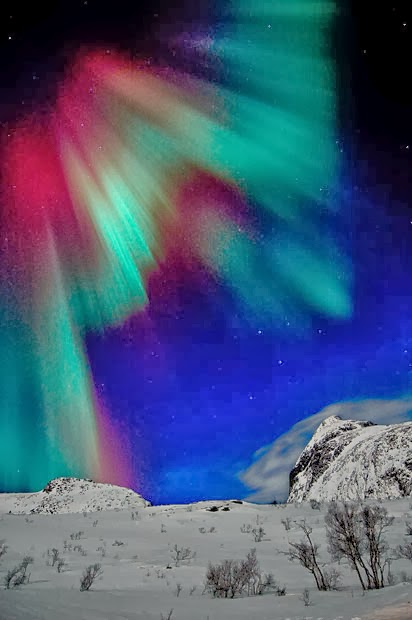
The magical northern lights. Credit: Bjorn Jorgensen / National News & Pictures
For example, coronal mass ejections (CMEs) occur most frequently during the peak periods of a solar cycle, and induce geomagnetic storms. Threats to Earth-orbiting telecommunication satellites in high, geosynchronous orbits are posed during these storms. The high currents that are discharged to the satellites can damage their components. Additionally, geomagnetic storms have been known to cause the temporary loss of electrical power over large regions, such the 1989 Quebec event. Understanding when and why CMEs occur can help plan for, and mitigate the effects of, geomagnetic storms on our telecommunication and electricity networks.

And some research has shown that the variable output of ultraviolet radiation through the course of a solar cycle can be tied to terrestrial climate changes. Climate scientists are now trying to make reliable climate predictions on decadal timescales, therefore sound solar predictions are important inputs for their models.

So with all this research in solar physics, why are predictions for the Sun's activity so seemingly unreliable? Physicists have observations from a host of solar satellites at their disposal, yet they seem to still be in the metaphorical dark.  Perhaps this complex problem will just a little bit longer to unravel, or maybe the timescales of study are too short?

And that's where my rule-bending rock postcard comes in.

I wonder if we can use material that the Apollo astronauts brought back from the Moon to increase the length of time over which we can study the Sun and its solar wind output. Back in 1970, scientists made measurements of noble gases (such as helium and argon) that were trapped inside tiny pieces of the lunar soil. And it is thought that those noble gases were implanted into the soil as the solar wind bombarded the Moon's ancient surface. So by studying these trapped pieces of the solar wind we can learn more about how the Sun has changed through time. If we had enough samples from discrete layers in the lunar surface we could even build up a record of this solar wind material that might help place the Sun's modern activity into a larger context and give the solar physicists a helping hand.

Color photograph of Apollo 11 lunar soil sample 10084. These grains are between 9000 and 10,000 mm. Credit: NASA / Johnson Space Center
We might still be learning and then re-learning things about our Sun, but I think it is important that we send one of these tiny Moon pebbles, complete with its trapped solar cargo, to our alien planetary geologist friends. They should know it is the Sun king who rules over us and our whole solar system. Maybe they could even help us decipher its mysteries.

Sunday, January 26, 2014

Wake up and taste the water

Comets have made the news a number of times in recent months. These interplanetary travellers, which were once thought to herald doom, are now known to be among the most primitive objects in the solar system. And of course, comets periodically make visits from the far reaches of the solar system (regions known as the Oort Cloud and the Kuiper belt) to our more local neighbourhood.

Back in December, Comet ISON—the 'comet of the century'—made a much-watched and disappointing suicide plunge into the Sun. And just this week, the European Space Agency successfully 'woke up' its Rosetta spacecraft from its two-and-a-half-year hibernation.

Currently more than 400 million miles away from home, Rosetta is journeying towards the comet 67P/Churyumov-Gerasimenko. Once it arrives, it will first orbit, and then land on the comet's surface. Together, the orbiter and lander portions of the spacecraft are equipped with over 20 scientific instruments that will make important characterizations of the comet. Scientists working on the mission hope to find out if comets such as this, which contain complex organic molecules, may have played a role in seeding life on Earth.


Artist's impression of the European Space Agency's Rosetta spacecraft orbiting the comet 67P/Churyumov-Gerasimenko. Credit: ESA, C.Carreau / ATG medialab
There has also been a long-lived debate over whether or not comets contributed significantly to the delivery, early in its history, of Earth's vast water inventory.

Because water is such a vital ingredient for the sustenance of life here on Earth, we target our search for extraterrestrial life on places where water exists. Water therefore seems like a pretty obvious choice for an Earth-material to send as one of our interplanetary postcards. But how might an alien scientist be able to tell our Earth-water apart from any other foreign H2O? We all know that water can vary drastically in its colour, salinity, taste, etc. So is there a characteristic signature of our water that portrays its Earthly provenance?

Earth: A water world. Credit: NASA
Lucky for us, chemistry has an answer. Hydrogen (H), like all elements is defined by the number of protons it contains. 'Normal' hydrogen contains just one proton in its nucleus. However, it is possible for a stable hydrogen atom to contain one or two neutrons in addition to the lone proton. The hydrogen isotope that has one proton and one neutron is known as deuterium (D). Heavy water is enriched in molecules that contain deuterium in place of the normal hydrogen.

Planetary scientists have shown that D/H ratios in water vary throughout the solar system. Measurements for a number of Oort Cloud comets reveal that they have D/H ratios which are more than twice the value for Earth's oceans, and are thus unlikely to have been the source of water on our planet.

Range of deuterium/hydrogen (D/H) ratios in solar system objects.
Credit: A. E. Saal et al. 2013, Science
Paul Hartogh and colleagues, however, showed in 2011 that a Jupiter-family comet (103P / Hartley 2), which probably originated from the Kuiper belt, has a D/H ratio that is much more consistent with that of Earth. This means that at least some of Earth's water may have been delivered by comets. Although in more recent work, Conel Alexander et al. argue that CI chondrites (the class of meteorite whose composition most closely resembles that of the Sun) were the principal source of terrestrial water.

And so the great water debate continues.  But no matter how, and from where, the water got here; get here it did. And we wouldn't be alive without it.

Wednesday, January 15, 2014

The Earth giveth and the Earth taketh away

We all know the story of the great big asteroid impact that brought about the demise of the dinosaurs (and this geological event is so popularly known that I'm sure it will feature as the subject of a future postcard). However, the dinosaur-ending mass extinction pales in comparison to one particular event that occurred about 250 million years ago.

This event marks the boundary between the Permian and Triassic geologic periods. The Permian was a time when the Earth contained a single supercontinent—Pangaea—vast areas of which were covered by arid deserts. But in a relatively abrupt period a large proportion of life on Earth was lost. In all, over 90% of marine species and 70% of terrestrial vertebrates became extinct.

The Pangaea supercontinent existed during the Permian and Triassic periods.
Credit: Mikkel Juul Jensen / Bonnier Publications / SPL
Until recently, however, the cause of this 'Great Dying' has remained unclear. But new work, presented at the American Geophysical Union's December 2013 Fall Meeting in San Francisco, provides us with a smoking gun.

Accurate measurements, conducted by geologists Seth Burgess and Samuel Browning at MIT, on rocks from Meishan in the Zhejiang Province of China give a new and precise age for the actual Permian–Triassic boundary that marks this extinction. They show that the extinction began 251.941 million years ago and lasted until 251.880 million years ago, i.e., lasting for 61,000 years.

That time frame shortly follows the first eruptions of vast volcanic flows in Siberia 252.28 million years ago. These Siberian Traps cover an area of about 2 million km2 (about the size of western Europe) and represent one of the largest eruptive events in Earth's history.


Part of the vast Siberian Traps. Credit: Jon Ranson
For decades scientists have questioned whether these two great, and closely spaced, markers in Earth's life could be linked and if the volcanic eruptions may have somehow caused the extinction. With the new age dating it is possible to at least show that the volcanism temporally preceded the mass extinction.  It is up to other scientists to work out what mechanism(s) link the two and could have caused so much destruction.

One recently proposed scenario sees huge amounts of sulfur dioxide from the volcanic eruptions being injected into the atmosphere. Acid rain, with the pH of lemon juice, would have then rained down on the northern hemisphere to wreak havoc on its vegetation and for the animals reliant upon it. Other materials, originating from the coal deposits through which the Siberian Traps were erupted, are likely to have been forced into the atmosphere. A resulting toxic metal-bearing layer of ash is thought to have blanketed the northern hemisphere and played a large part in the extinction event.

Although our Earth provides us with the conditions and materials to sustain life, it can also turn on its geological nastiness from time to time and try its hardest to kill us. I'd send some of these informative rocks from southern China and Siberia into space for one of our alien planetary geologists to find. So they know just how Mother Earth likes to do her 'loving'.

Thursday, January 02, 2014

Tardi and hardy space travellers

Recently, this BBC headline caught my eye:


The piece focuses on an Astrobiology research article by Worth et al. In the paper the authors consider the likelihood that rocks ejected from Earth (or Mars) during large meteor impacts launched life-bearing materials into space. It is possible, they claim, that such rocks could reach other planets or moons in the solar system, where the life could resettle and colonize. This concept—known as lithopanspermia—isn't new, but their statistical approach to the problem is.

Back in 1996 a meteorite found in Antarctica, but which originated from Mars, known as Allan Hills 84001 (ALH 84001) hit the news. NASA scientists claimed that this rock contained evidence of life once having existed on Mars.

Electron microscope image of 'fossilized microbes' in the Allan Hills 84001 meteorite. Credit: NASA
Obviously this controversial subject has been disputed ever since and it has been shown that all the rock's 'biosignatures' can be produced inorganically, i.e., without the need to invoke life.

Whether or not this particular meteorite contains ancient martian lifeforms, it prompts an interesting question that links back to the subject of lithopanspermia. Is it possible for life from Earth to be exported? If we were to pick an organism to undertake this journey, what would it be? And what rock would we encase this organism in, to try and ensure its survival?

I've never been a big fan of bugs, in fact I'm pretty terrified of anything with more than four legs. However, I recently became aware that a group of organisms known as tardigrades exist. And even I have to admit that these little monsters are cool.

A tardigrade in moss. Credit: Eye of Science / Science Source Images
Tardigrades are classified as extremophiles, organisms that can survive in some of Earth's most difficult conditions. But these guys take the term to the extreme—they're pretty much indestructible. They can withstand temperatures that range from just above absolute zero to more than the boiling point of water, pressures greater than at the deepest ocean trenches, and the vacuum of space along with its harsh radiation conditions. So my vote goes to the tardigrades as the space-faring guinea pigs that get to be sent on a one-way (and potentially suicidal) mission to somewhere.

The encasement of rock around our tardigrades must also be chosen carefully. The material needs to be strong enough to survive two impacts: the large meteor event that expels the material into space, and the sample landing on the surface of its destination. Hardy quartzite, the metamorphic product of simple sandstone, would probably be a good option. Or perhaps a material similar to that of ALH 84001, i.e., an igneous rock called orthopyroxenite, would meet the requirements.

I don't know if life on Earth originated through lithopanspermia, or if life exists elsewhere because of it, but I do quite like the idea of the hardy tardigrades ruling some distant planet.