Monday, January 26, 2015

A peace of Earth offering

In recent weeks this interesting science story has caught my attention. A group of scientists has been tasked with deciding whether we are in the midst of a new geologic epoch, and if so, what historical event can be used to mark its beginning. The potential new epoch is known as the anthropocenethe 'human epoch'and is defined as the period in which human activities have had a significant impact on the Earth and its ecosystems.

Several sensible options have been put forward as possible start points for the anthropocene. These include the invention and rise of agriculture about 10,000 years ago, or the start of the Industrial Revolution in the 18th Century. It seems, however, that these choices have lost out to the might and power of an atomic option.

A group of researchers, led by Jan Zalasiewicz at the University of Leicester, have proposed that the new epoch began with the dawn of the atomic age. They suggest that the first nuclear bomb test, on 16th July 1945 in the Jornada del Muerto desert of New Mexico, marks the moment in time when humankind left its first permanent and global imprint on Earth.

Rising fireball and forming mushroom cloud, nine seconds after the world's first atomic bomb was detonated on 16th July 1945 in New Mexico. Credit: U.S. Department of Defense

Earth's geologic timescale is divided into units of various lengths that stretch back to the planet's formation about 4.54 billion years ago. Any given eon, era, period, or epoch consists of characteristic rock strata that can be distinguished from those that are directly above (younger) and below (older) it. Often, these stratigraphic boundaries are marked by major compositional or paleontological changes, such as mass extinctions. If the anthropocene is to be added to the top of Earth's stratigraphic column, it therefore makes sense to identify its beginning with a similarly global signature.

The geologic timescale. Credit: Science Education Resource Center at Carleton College

Luckily, as Zalasiewicz and colleagues point out, the nuclear tests that took place between 1945 and 1963 caused an unambiguous and detectable change in the Earth's atmosphere. The nuclear explosions were the primary source of man-made radionuclides (i.e., radioactive isotopes) found in the atmosphere. The most abundant of these nuclidescaesium-137has no natural sources and is the product of nuclear fission processes. The first pronounced increase in the atmospheric concentration of Cs-137 occurred in 1954, and there was an additional peak in 1963. Man-made radionuclides therefore represent the best chronological markers for the atomically-heralded anthropocene.

Fallout of anthropogenic radionuclides (including caesium-137). Credit: Hancock et al., 2014, Geol. Soc. London

I think it is pretty obvious that a piece of the anthropocene Earth should be sent into the cosmos as our next geological postcard. This period, in which humans have begun to leave an indelible mark on our planet, is uniquely representative of Earth's capacity to support intelligent life. Caesium-137, however, with a half-life of only 30 years, is not a great choice. It will not be able to journey very far into the vast expanse of the universe before it decays away to almost nothing. So instead, I'd like to send an actual rock that is a direct product of the first nuclear test.

After the bomb detonation on 16 July 1945, a glassy residue was left on the desert floor at the 'Trinity' test site. The glassy deposit is composed mainly of feldspar and quartz-rich sand grains that were melted during the blast. This rock—known as trinitite, after its type locality—is usually light green in colour, and is mildly radioactive.

A trinitite hand specimen, produced by the first nuclear bomb detonation. Credit: Paul M. Schumacher
 
I like to think that our hypothetical alien planetary geologists are a friendly race and would extend a hand of peace if we ever encounter them. As evidenced by the anthropocene, we are now able to alter the workings of our own planet. So let those aliens beware the destruction we would unleashIndependence Day styleif they turn out to be not quite that welcoming. A piece of trinitite should therefore serve as a suitable example of the awesome and destructive power humankind can wield when we put our mind to it.

Wednesday, December 17, 2014

This time, it's quantity that counts

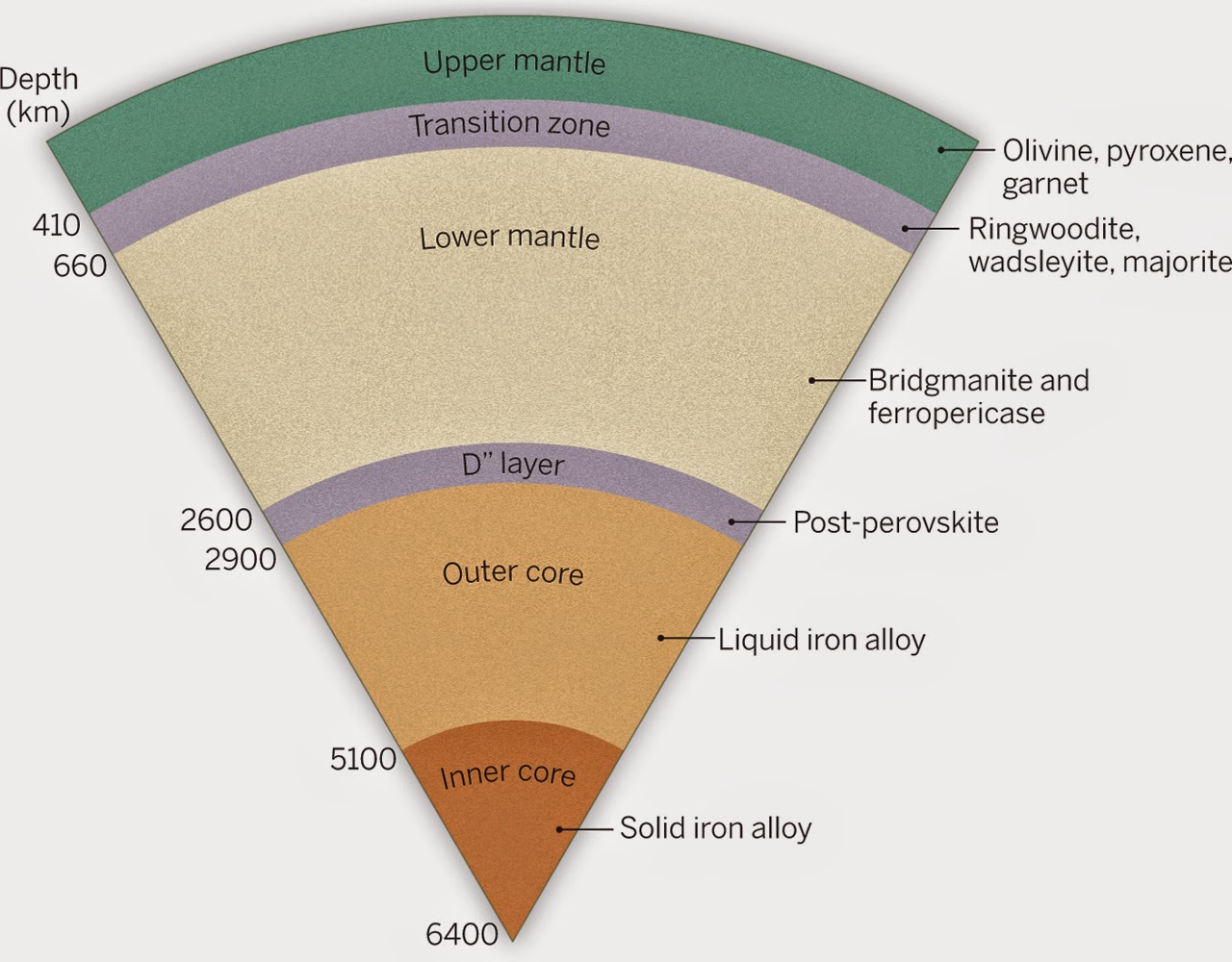
If we were to rank all the minerals within Earth by their abundance, and use that ranking to pick a candidate for our interplanetary adventure, then we would have an easy winner. This mineral—which makes up about 38% of the Earth's volume—is thought to be the most abundant on our planet. It has been known for some time that this silicate mineral—(Mg,Fe)SiO3—has what is known as an orthorhombic ABO3 perovskite structure. Until very recently, however, it did not actually have a name. But now, based on work described in a new study published a few weeks ago in Science, the first detailed characterization of this long-known mineral phase has been conducted, and the mineral has finally been named.

The 'ABO3 perovskite structure'.  Credit: T. Imai et al./NTT Photonics Laboratories
Through the study of seismic waves, i.e., the energy generated by earthquakes, scientists can learn about Earth's interior structure. At certain depths—known as discontinuities—below the planet's surface the propagation of these waves changes abruptly. It is these changes in seismic wave velocity that help us build up a picture of the Earth's innards, in which a solid inner core, a liquid outer core, the lower mantle, and the upper mantle lie beneath the crust.

Interior structure of the Earth, showing the dominant mineral species in each layer.
Credit: P. Huey/Science
As I discussed in a previous postcard, getting samples from deep within the Earth is not easy. Such materials normally take the form of diamonds or xenoliths, and tend to come from the upper mantle. But most material from the lower mantle—the region where our previously elusive mineral resides—does not survive the trip to the Earth's surface, and is therefore not readily accessible for geologic study. A combination of very high-pressure experiments, thermodynamic calculations, and first-principle modelling studies are therefore required to discern the major mineral constituents in each of these unreachable layers.

Official mineral names are approved by the International Mineralogical Association. But to suggest a name for a mineral through these official channels, its structure must be characterised from a naturally occurring sample. And this is the reason why our abundant mineral from the lower mantle has remained nameless for so long. In the absence of a suitable sample, researchers have been unable to conduct the required structural characterizations and therefore no name could be assigned. 

But in the recently published work by Oliver Tschauner (University of Nevada, Las Vegas) and colleagues, a meteorite sample (Tenham) has come to the mineralogical nomenclature rescue. The authors have studied part of this chondrite, which fell and was then recovered from a remote part of western Queensland, Australia, in 1879. During a brief impact event, the parent body (i.e., an asteroid) of this meteorite experienced a period of very high pressures (more than 25 GPa) and temperatures (about 2500 K). These conditions are comparable to those in parts of Earth's deep interior. During this impact, some material melted and formed so-called shock veins. It is within these veins that Tschauner et al., found clasts of the 'missing' mineral to study.

Having found the required sample they next undertook a series of synchroton micro-X-ray diffraction and electron probe microanalysis measurements to definitively determine the mineral's crystal structure and composition. Their results were sufficient to meet the stringent requirements of the International Mineralogical Association, and the authors were finally able to propose a name for Earth's most abundant mineral. The name they settled on—bridgmanite—was chosen to honour the Nobel Prize laureate Percy W. Bridgman (1882–1961). His serendipitous machinery malfunction led to pioneering work in the field of high-pressure experiments, which paved the way for the field of modern-day mineral physics and our understanding of Earth's interior.

Percy W. Bridgman. Credit: Smithsonian Institution
The Tenham meteorite—together with the newly named bridgmanite it contains—is yet another example of a geologic specimen I am choosing for our cosmological journey, which is not quite of the Earth. But with a hefty 38% of the mineralogical vote, brigmanite is a serious contender that cannot be ignored. So until we devise a way to get a terrestrial sample of Earth's most abundant mineral from the lower mantle itself, this meteorite will just have to do.

A thin section from the Tenham meteorite, from which newly-named bridgmanite was identified and characterized. Credit: Chi Ma